The system I built to take creative strategy from research to ads.
I built this system to do my creative strategy work. It reads what customers say, works out who an ad is for, writes the bet down before anything runs, and drafts the briefs and the ads. It started as prompts when I was at Tier 11. Now it runs in code with a database, and I work with it through Claude and Codex.
What it does
Creative strategy is working out who an ad is for, what that person believes right now, and what would make them buy. Most of that work is reading. You read what real customers write, in their own words, until the same worries and wants keep coming up. Then you decide what to try.
The system does the reading and the first drafts, so I can spend my time on the decisions. Here is what goes in, what comes out, and where I decide.
-
Step 1: What goes in
What customers say in their own words: reviews, comments, forums. And the ads the brand is already running.
-
Step 2: Who it’s for
A map of the people who could buy. Then one narrow audience to go after.
I choose the audience
-
Step 3: What they believe
What that person believes now, and what they would need to believe to buy.
-
Step 4: The bet
Written down before anything runs: what we’re trying, how big a swing it is, and what we expect.
I choose which bets run
-
Step 5: Briefs and ads
Opening lines drafted and graded, the briefs, then the ads themselves.
I check every claim and approve every launch
-
Step 6: The reading
Once enough real results are in: keep going, grow it, stop it, or call it unclear. Unclear is never a win.
What a reading teaches goes into the next bet.
Every test
How a bet gets written down
Every ad is a bet. Some are big swings with low odds and a lot to win. Most are small changes with good odds of a small win. A healthy plan carries both.
One of the main concepts is that creative strategy is about making bets. Sometimes they’re big, risky bets, meaning lower confidence in success but a high opportunity, versus low-risk bets, which are more iterations with high confidence in small success.
So before a test runs, the system writes the bet down: what we’re trying, how big a swing it is, and what we expect to happen. It makes its own estimate of the odds first. Then other AI models make theirs without seeing it, and I can add mine.
Once a bet is written, nobody edits it. If the bet changes, a new one is written beside the old one, so I can always see what I expected at the time. When enough real results have come in, the bet is read honestly. It keeps going, it grows, it’s stopped, or it’s called unclear. An unclear result is never called a win.
2018 to 2022
At Tier 11, by hand
Tier 11 is a performance marketing agency. I spent about six years there, and for much of that time I led the creative team, working for about forty clients at once. This is where the method got written down, long before any of it was software.
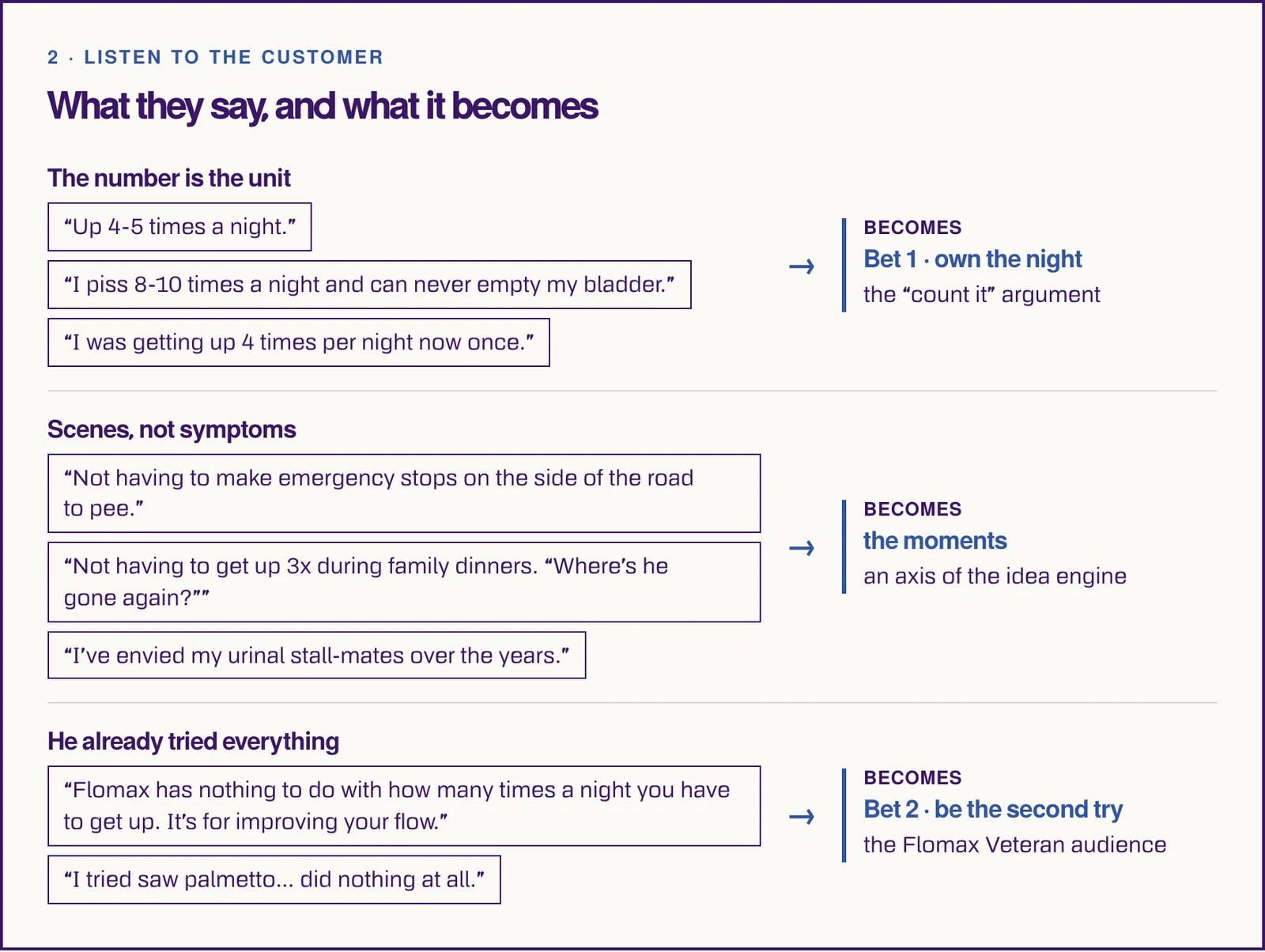
We go out and we don’t just make up the avatars as we imagine them. We dive deep into their customer reviews, Amazon reviews, go into Reddit forums, see what people are saying about Twitter, even going onto Facebook ad comments, and really just pulling out the information in the customer’s own words.
It took us a while to get there. For my first two years, we mostly made up the customer based on what we thought was best. Reading what buyers actually wrote changed all of the creative, not only the copy.
The tendency is often to try to pull out the positive, but the negative is where the gold is.
The bets were there too, before I called them that. Before a test, I said what I expected and why. In 2022 I turned another agency’s public quiz into a game for the team: look at two ads, pick the one that performed better, and say why.
I’ll go with ad 1. Ad 2 doesn’t say what the product does until the 30s mark. Also, having a variety of people makes the testimonials in Ad 1 feel more authentic… plus the CTA is simpler. I’m ready to be wrong.
2020 to 2023
At Tier 11, the first AI tools
I started as a sceptic.
I’m not convinced that AI can solve things. But, I look forward to being proven wrong.
In 2021 I asked Tier 11 to pay for an AI copy tool built on GPT-3 for the creative team. Later that year we rolled it out to the whole agency, and creative strategy ideas were one of the jobs I gave it.
GPT3/Jarvis is not as bad as copywriters claim nor as good as non-copywriters believe. The trick is learning how to get the outputs you want. It’s not as simple as “make ad”.
ChatGPT came out at the end of November 2022. Within a few weeks the team had an account, I had shown the creative team what it was good for, and I had built bots for them in our Slack. The first thing on my list of what it did well: “It solves the ‘blank page problem’.”
In March 2023 I fed the company handbook into a chat as one long prompt. That was the first time I gave a model a lot of context at once and asked it to work from that. In June 2023 I got access to Claude.
Has anyone used Claude from Anthropic yet? I just got access, but I haven’t yet figured out what it’s good for.
Later
From a chat to Claude Projects
After that, the work moved in steps. First I fed a lot of context into a chat each time I started: the research, the method, the past work. Then I moved to Claude Projects, which keep that context with the model from one conversation to the next.
It went from feeding lots of context into a chat to taking advantage of Claude projects, to the point we are now, where we have the system built out in code with databases and whatever else exists.
2026
In code, with a database
In September 2026 I ran a whole creative strategy for Protaflo, a prostate supplement, from customers’ words to five briefs, as spec work. Nobody hired me, and none of it ran. That run became the pattern. Later that month the system moved into code, with a database that keeps the research, the audiences, the beliefs and every bet in one place.
Now I work with it through AI models like Claude and Codex. I ask, it does the reading and the drafting, and the database keeps everything it learns. By the end of September I wanted the system to put the odds on each bet itself, not me.
Why am I setting a probability? I am expecting our system to do it, or you, or any of our other agents that we’re calling.
So far I’ve used it on two spec projects, Protaflo and Emma Relief, and on my wife’s shop, and I’m starting on SuperHired. It hasn’t run on a client account yet, so there are no client results from it.
One run, from a customer’s own words to the brief they became, is on the Protaflo page.
Additional work experience
The jobs I had before Tier 11, from local TV news to animation and producing. Each one shows up somewhere in how I work.
2002 to 2005
KABC-TV
Straight out of college I worked the news at ABC7 in Los Angeles: running scripts to the talent and running the teleprompter.
2005 to 2009
Walt Disney Animation Studios
About five years in production on one film. I started as a production assistant in look development on American Dog, the film that became Bolt, and finished as Publicity and Art Department Manager.
Internationally, every department that needed stuff from production came through me. I worked with all the internal department heads and the producer to get what we needed to the right people so that the film was successfully launched across all of the different channels and surfaces.
2014 to 2017
Coffee Blocks
My own product: an instant butter coffee I invented and took to Kickstarter. I did everything from the recipe to the ads.
One film got a lot of views and did nothing for sales, which is how I learned that views are not sales.
2015 to 2018
Sons of Summer
Supervising producer at a production company in Burbank, making films for brands and studios such as Hot Wheels, Freeform and Seven Bucks Digital Studios.
The clients would have an objective. They would need creative to achieve that objective, and we would do the strategy and production for that.
Not shown
Held. Not shown here
The chart my team built at Tier 11 of how aware a buyer is
It was made at Tier 11 and it belongs to Tier 11, so it isn’t shown here. How I use the levels is on the How I work page.